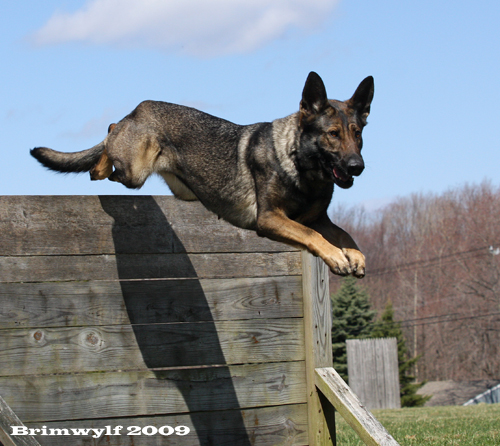
Jumps and Walls
Teaching correct jumping and wall scaling technique is important for the safety of the dog as well as points. A young dog should not start regular jumping until he is fully co-ordinated and his joints have been checked out around 1 year to 18 months of age, although a couple of low jumps as a puppy will not hurt. I begin by setting my solid schutzhund jump at the height just above the dogs knee. This height will not tip him over onto his face if he knocks it, but by starting over a solid jump, he learns to clear the jump, since it will not fall if he knocks it. I gradually work up to around shoulder / wither height. One option for teaching good jumping technique is the Suzanne Clothier's natural jumping method which consists of various exercises over a sequence of jumps.
Other jumping exercises which help with technique include jumping a single jump with lowered head, many agility trainers start this way. This exercise is started with a pole on the ground and gradually worked up in height until the dog can clear around shoulder height.
Move up gradually to the full size schutzhund jump. It is important that the dog jumps this height, or even a few inches higher as they acquire muscle memory for that height, and if you routinely jump lower than full height, you will find that the dog knocks the jump at the trial. It also helps to spend time jumping the jump without the retrieve or a ball, because the additional drive can cause the dog to flatten or hit the jump.
Wall (A-Frame)
Teaching the wall can begin when the dog is a puppy, set it no more than 3 feet from the ground at the highest point, and guide him over with a leash, ball or food, be sure to get excited and play afterwards. Gradually raise the wall as the pup gets more confident. Puppies can also learn much of the agility equipment. This helps raise awareness of their back legs and helps build confidence. Quite a few agility clubs offer a puppy class which many handlers and their dogs enjoy.Once the pup is big and strong enough, you can raise the wall gradually to regulation height. It is important for his own safety that the dog does not learn to fly off the top. One way to teach this, is to teach him to target, then place that target close to the the foot of the wall. Give your targeting command as the dog comes towards the target, so that he slows down and stops on the target, then feed him on the target and release. You can move the targets so that the dog learns to jump from different areas and angles, this helps him learn technique for the wall and judge take off for the jump.
I like to incorporate the jump and the wall with targets each side when I am conditioning our dogs and getting them ready for trial, this helps build up the shoulder and rear muscles. I typically start with 10 minutes of walking or jogging, followed by a blind search, then move on to jumps and walls.